New Environment: Creating and Modeling
In this notebook, we will show how to extend RL4CO to solve new problems from zero to hero! 🚀

Contents
Problem: TSP
We will build an environment and model for the Traveling Salesman Problem (TSP). The TSP is a well-known combinatorial optimization problem that consists of finding the shortest route that visits each city in a given list exactly once and returns to the origin city. The TSP is NP-hard, and it is one of the most studied problems in combinatorial optimization.
Installation
[23]:
## Uncomment the following line to install the package from PyPI
## You may need to restart the runtime in Colab after this
## Remember to choose a GPU runtime for faster training!

# !pip install rl4co
Imports
[24]:
from typing import Optional
import torch
import torch.nn as nn

from tensordict.tensordict import TensorDict
from torchrl.data import (
    BoundedTensorSpec,
    CompositeSpec,
    UnboundedContinuousTensorSpec,
    UnboundedDiscreteTensorSpec,
)

from rl4co.models.nn.utils import rollout, random_policy
from rl4co.envs.common.base import RL4COEnvBase
from rl4co.models.zoo import AttentionModel, AutoregressivePolicy
from rl4co.utils.ops import gather_by_index, get_tour_length
from rl4co.utils.trainer import RL4COTrainer
Environment Creation
We will base environment creation on the RL4COEnvBase class, which is based on TorchRL. More information in documentation!
Reset
The _reset function is used to initialize the environment to an initial state. It returns a TensorDict of the initial state.
[25]:
def _reset(self, td: Optional[TensorDict] = None, batch_size=None) -> TensorDict:
    # Initialize locations
    init_locs = td["locs"] if td is not None else None
    if batch_size is None:
        batch_size = self.batch_size if init_locs is None else init_locs.shape[:-2]
    device = init_locs.device if init_locs is not None else self.device
    self.to(device)
    if init_locs is None:
        init_locs = self.generate_data(batch_size=batch_size).to(device)["locs"]
    batch_size = [batch_size] if isinstance(batch_size, int) else batch_size

    # We do not enforce loading from self for flexibility
    num_loc = init_locs.shape[-2]

    # Other variables
    current_node = torch.zeros((batch_size), dtype=torch.int64, device=device)
    available = torch.ones(
        (*batch_size, num_loc), dtype=torch.bool, device=device
    )  # 1 means not visited, i.e. action is allowed
    i = torch.zeros((*batch_size, 1), dtype=torch.int64, device=device)

    return TensorDict(
        {
            "locs": init_locs,
            "first_node": current_node,
            "current_node": current_node,
            "i": i,
            "action_mask": available,
            "reward": torch.zeros((*batch_size, 1), dtype=torch.float32),
        },
        batch_size=batch_size,
    )
Step
Environment _step: this defines the state update of the TSP problem gived a TensorDict (td in the code) of the current state and the action to take:
[26]:
def _step(self, td: TensorDict) -> TensorDict:
    current_node = td["action"]
    first_node = current_node if td["i"].all() == 0 else td["first_node"]

    # Set not visited to 0 (i.e., we visited the node)
    # Note: we may also use a separate function for obtaining the mask for more flexibility
    available = td["action_mask"].scatter(
        -1, current_node.unsqueeze(-1).expand_as(td["action_mask"]), 0
    )

    # We are done there are no unvisited locations
    done = torch.sum(available, dim=-1) == 0

    # The reward is calculated outside via get_reward for efficiency, so we set it to 0 here
    reward = torch.zeros_like(done)

    td.update(
        {
            "first_node": first_node,
            "current_node": current_node,
            "i": td["i"] + 1,
            "action_mask": available,
            "reward": reward,
            "done": done,
        },
    )
    return td
[Optional] Separate Action Mask Function
The get_action_mask function simply returns a mask of the valid actions for the current updated state. This can be used in _step and _reset for larger environments with several constraints and may be useful for modularity
[27]:
def get_action_mask(self, td: TensorDict) -> TensorDict:
    # Here: your logic
    return td["action_mask"]
[Optional] Check Solution Validity
Another optional utility, this checks whether the solution is feasible and can help identify bugs
[28]:
def check_solution_validity(self, td: TensorDict, actions: torch.Tensor):
    """Check that solution is valid: nodes are visited exactly once"""
    assert (
        torch.arange(actions.size(1), out=actions.data.new())
        .view(1, -1)
        .expand_as(actions)
        == actions.data.sort(1)[0]
    ).all(), "Invalid tour"
Reward function
The get_reward function is used to evaluate the reward given the solution (actions).
[29]:
def get_reward(self, td, actions) -> TensorDict:
    # Sanity check if enabled
    if self.check_solution:
        self.check_solution_validity(td, actions)

    # Gather locations in order of tour and return distance between them (i.e., -reward)
    locs_ordered = gather_by_index(td["locs"], actions)
    return -get_tour_length(locs_ordered)
Environment Action Specs
This defines the input and output domains of the environment - similar to Gym’s spaces. This is not strictly necessary, but it is useful to have a clear definition of the environment’s action and observation spaces and if we want to sample actions using TorchRL’s utils
Note: this is actually not necessary, but it is useful to have a clear definition of the environment’s action and observation spaces and if we want to sample actions using TorchRL’s utils
[30]:
def _make_spec(self, td_params):
    """Make the observation and action specs from the parameters"""
    self.observation_spec = CompositeSpec(
        locs=BoundedTensorSpec(
            minimum=self.min_loc,
            maximum=self.max_loc,
            shape=(self.num_loc, 2),
            dtype=torch.float32,
        ),
        first_node=UnboundedDiscreteTensorSpec(
            shape=(1),
            dtype=torch.int64,
        ),
        current_node=UnboundedDiscreteTensorSpec(
            shape=(1),
            dtype=torch.int64,
        ),
        i=UnboundedDiscreteTensorSpec(
            shape=(1),
            dtype=torch.int64,
        ),
        action_mask=UnboundedDiscreteTensorSpec(
            shape=(self.num_loc),
            dtype=torch.bool,
        ),
        shape=(),
    )
    self.action_spec = BoundedTensorSpec(
        shape=(1,),
        dtype=torch.int64,
        minimum=0,
        maximum=self.num_loc,
    )
    self.reward_spec = UnboundedContinuousTensorSpec(shape=(1,))
    self.done_spec = UnboundedDiscreteTensorSpec(shape=(1,), dtype=torch.bool)
Data generation
This function allows for generating data for training instances if no data is provided.
[31]:
def generate_data(self, batch_size) -> TensorDict:
    batch_size = [batch_size] if isinstance(batch_size, int) else batch_size
    locs = (
        torch.rand((*batch_size, self.num_loc, 2), generator=self.rng)
        * (self.max_loc - self.min_loc)
        + self.min_loc
    )
    return TensorDict({"locs": locs}, batch_size=batch_size)
Render function
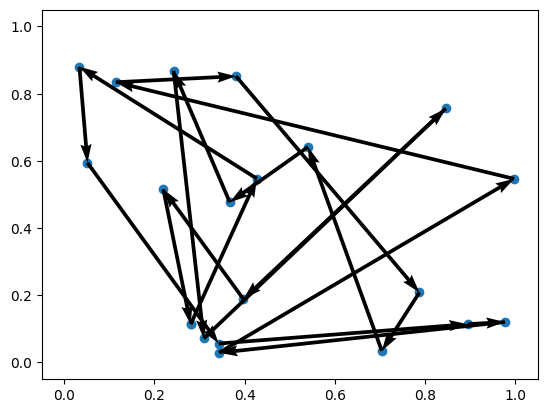
The render function is optional, but can be useful for quickly visualizing the results of your algorithm!
[32]:
def render(self, td, actions=None, ax=None):
    import matplotlib.pyplot as plt
    import numpy as np

    if ax is None:
        # Create a plot of the nodes
        _, ax = plt.subplots()

    td = td.detach().cpu()

    if actions is None:
        actions = td.get("action", None)
    # if batch_size greater than 0 , we need to select the first batch element
    if td.batch_size != torch.Size([]):
        td = td[0]
        actions = actions[0]

    locs = td["locs"]

    # gather locs in order of action if available
    if actions is None:
        print("No action in TensorDict, rendering unsorted locs")
    else:
        actions = actions.detach().cpu()
        locs = gather_by_index(locs, actions, dim=0)

    # Cat the first node to the end to complete the tour
    locs = torch.cat((locs, locs[0:1]))
    x, y = locs[:, 0], locs[:, 1]

    # Plot the visited nodes
    ax.scatter(x, y, color="tab:blue")

    # Add arrows between visited nodes as a quiver plot
    dx, dy = np.diff(x), np.diff(y)
    ax.quiver(
        x[:-1], y[:-1], dx, dy, scale_units="xy", angles="xy", scale=1, color="k"
    )

    # Setup limits and show
    ax.set_xlim(-0.05, 1.05)
    ax.set_ylim(-0.05, 1.05)
Putting everything together
[33]:
class TSPEnv(RL4COEnvBase):
    """Traveling Salesman Problem (TSP) environment"""

    name = "tsp"

    def __init__(
        self,
        num_loc: int = 20,
        min_loc: float = 0,
        max_loc: float = 1,
        td_params: TensorDict = None,
        **kwargs,
    ):
        super().__init__(**kwargs)
        self.num_loc = num_loc
        self.min_loc = min_loc
        self.max_loc = max_loc
        self._make_spec(td_params)

    _reset = _reset
    _step = _step
    get_reward = get_reward
    check_solution_validity = check_solution_validity
    get_action_mask = get_action_mask
    _make_spec = _make_spec
    generate_data = generate_data
    render = render
[34]:
batch_size = 2

env = TSPEnv(num_loc=20)
reward, td, actions = rollout(env, env.reset(batch_size=[batch_size]), random_policy)
env.render(td, actions)
Modeling
Now we need to model the problem by transforming input information into the latent space to be processed. In RL4CO, we divide embeddings in 3 parts:
init_embedding: embed initial states of the problemcontext_embedding: embed context information of the problem for the current partial solution to modify the querydynamic_embedding: embed dynamic information of the problem for the current partial solution to modify the query, key, and value (i.e. if other nodes also change state)
Init Embedding
Embed initial problem into latent space. In our case, we can project the coordinates of the cities into a latent space.
[35]:
class TSPInitEmbedding(nn.Module):
    """Initial embedding for the Traveling Salesman Problems (TSP).
    Embed the following node features to the embedding space:
        - locs: x, y coordinates of the cities
    """

    def __init__(self, embedding_dim, linear_bias=True):
        super(TSPInitEmbedding, self).__init__()
        node_dim = 2  # x, y
        self.init_embed = nn.Linear(node_dim, embedding_dim, linear_bias)

    def forward(self, td):
        out = self.init_embed(td["locs"])
        return out
Context Embedding
Context embedding takes the current context and returns a vector representation of it. In TSP, we can take the embedding of the first node visited (since we need to complete the tour) as well as the embedding of current node visited (in the first step we just have a placeholder since they are the same).
[36]:
class TSPContext(nn.Module):
    """Context embedding for the Traveling Salesman Problem (TSP).
    Project the following to the embedding space:
        - first node embedding
        - current node embedding
    """

    def __init__(self, embedding_dim,  linear_bias=True):
        super(TSPContext, self).__init__()
        self.W_placeholder = nn.Parameter(
            torch.Tensor(2 * embedding_dim).uniform_(-1, 1)
        )
        self.project_context = nn.Linear(
            embedding_dim*2, embedding_dim, bias=linear_bias
        )

    def forward(self, embeddings, td):
        batch_size = embeddings.size(0)
        # By default, node_dim = -1 (we only have one node embedding per node)
        node_dim = (
            (-1,) if td["first_node"].dim() == 1 else (td["first_node"].size(-1), -1)
        )
        if td["i"][(0,) * td["i"].dim()].item() < 1:  # get first item fast
            context_embedding = self.W_placeholder[None, :].expand(
                batch_size, self.W_placeholder.size(-1)
            )
        else:
            context_embedding = gather_by_index(
                embeddings,
                torch.stack([td["first_node"], td["current_node"]], -1).view(
                    batch_size, -1
                ),
            ).view(batch_size, *node_dim)
        return self.project_context(context_embedding)
Dynamic Embedding
Since the states do not change except for visited nodes, we do not need to modify the keys and values. Therefore, we set this to 0
[37]:
class StaticEmbedding(nn.Module):
    def __init__(self, *args, **kwargs):
        super(StaticEmbedding, self).__init__()

    def forward(self, td):
        return 0, 0, 0
Training our Model
[38]:
# Instantiate our environment
env = TSPEnv(num_loc=20)

# Instantiate policy with the embeddings we created above
emb_dim = 128
policy = AutoregressivePolicy(env,
                              embedding_dim=emb_dim,
                              init_embedding=TSPInitEmbedding(emb_dim),
                              context_embedding=TSPContext(emb_dim),
                              dynamic_embedding=StaticEmbedding(emb_dim)
)


# Model: default is AM with REINFORCE and greedy rollout baseline
model = AttentionModel(env,
                       policy=policy,
                       baseline='rollout',
                       train_data_size=100_000,
                       val_data_size=10_000)
/home/botu/mambaforge/envs/rl4co-new/lib/python3.11/site-packages/lightning/pytorch/utilities/parsing.py:198: Attribute 'env' is an instance of `nn.Module` and is already saved during checkpointing. It is recommended to ignore them using `self.save_hyperparameters(ignore=['env'])`.
/home/botu/mambaforge/envs/rl4co-new/lib/python3.11/site-packages/lightning/pytorch/utilities/parsing.py:198: Attribute 'policy' is an instance of `nn.Module` and is already saved during checkpointing. It is recommended to ignore them using `self.save_hyperparameters(ignore=['policy'])`.
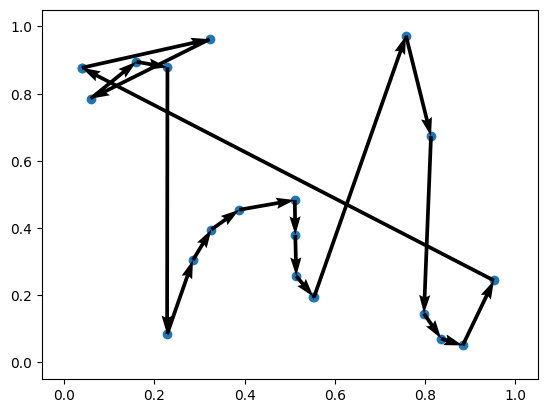
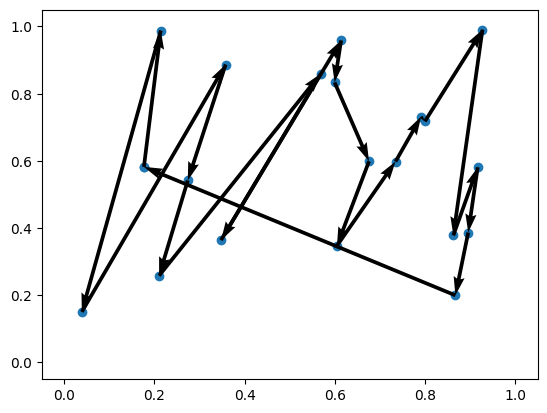
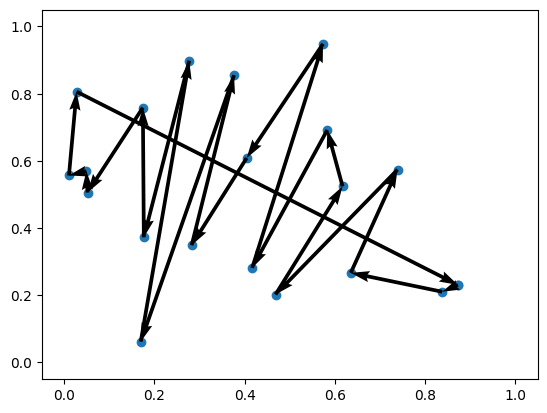
Rollout untrained model
[39]:
# Greedy rollouts over untrained model
device = torch.device("cuda" if torch.cuda.is_available() else "cpu")
td_init = env.reset(batch_size=[3]).to(device)
model = model.to(device)
out = model(td_init.clone(), phase="test", decode_type="greedy", return_actions=True)
actions_untrained = out['actions'].cpu().detach()
rewards_untrained = out['reward'].cpu().detach()

for i in range(3):
    print(f"Problem {i+1} | Cost: {-rewards_untrained[i]:.3f}")
    env.render(td_init[i], actions_untrained[i])
Problem 1 | Cost: 5.558
Problem 2 | Cost: 7.984
Problem 3 | Cost: 8.112
Training loop
[40]:
# We use our own wrapper around Lightning's `Trainer` to make it easier to use
trainer = RL4COTrainer(max_epochs=3, devices=1)
trainer.fit(model)
Using 16bit Automatic Mixed Precision (AMP)
GPU available: True (cuda), used: True
TPU available: False, using: 0 TPU cores
IPU available: False, using: 0 IPUs
HPU available: False, using: 0 HPUs
val_file not set. Generating dataset instead
test_file not set. Generating dataset instead
LOCAL_RANK: 0 - CUDA_VISIBLE_DEVICES: [0,1]

  | Name     | Type                 | Params
--------------------------------------------------
0 | env      | TSPEnv               | 0
1 | policy   | AutoregressivePolicy | 710 K
2 | baseline | WarmupBaseline       | 710 K
--------------------------------------------------
1.4 M     Trainable params
0         Non-trainable params
1.4 M     Total params
5.682     Total estimated model params size (MB)
Epoch 2: 100%|██████████| 196/196 [00:05<00:00, 39.14it/s, v_num=3, train/reward=-4.00, train/loss=-.048, val/reward=-3.99]
`Trainer.fit` stopped: `max_epochs=3` reached.
Epoch 2: 100%|██████████| 196/196 [00:09<00:00, 21.40it/s, v_num=3, train/reward=-4.00, train/loss=-.048, val/reward=-3.99]
Evaluation
[41]:
# Greedy rollouts over trained model (same states as previous plot)
model = model.to(device)
out = model(td_init.clone(), phase="test", decode_type="greedy", return_actions=True)
actions_trained = out['actions'].cpu().detach()

# Plotting
import matplotlib.pyplot as plt
for i, td in enumerate(td_init):
    fig, axs = plt.subplots(1,2, figsize=(11,5))
    env.render(td, actions_untrained[i], ax=axs[0])
    env.render(td, actions_trained[i], ax=axs[1])
    axs[0].set_title(f"Untrained | Cost = {-rewards_untrained[i].item():.3f}")
    axs[1].set_title(r"Trained $\pi_\theta$" + f"| Cost = {-out['reward'][i].item():.3f}")
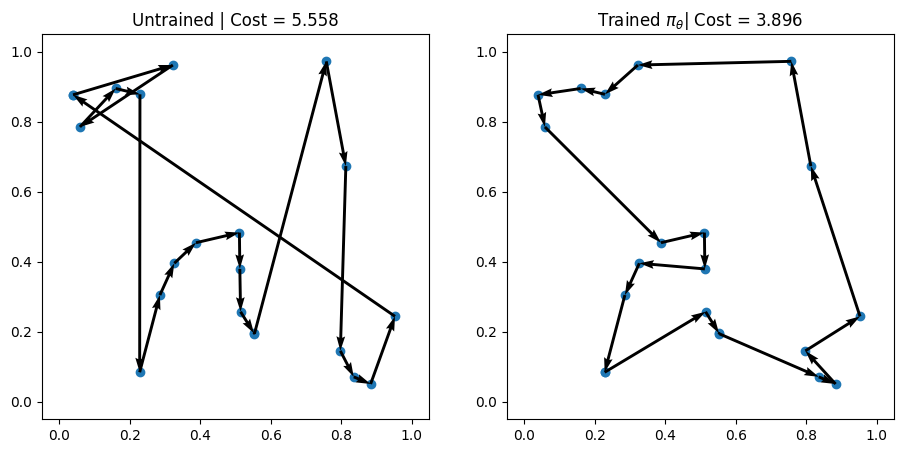
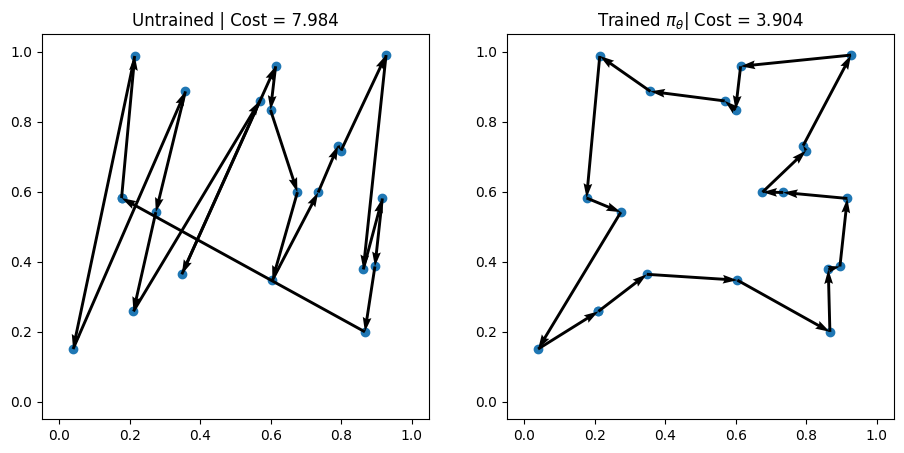
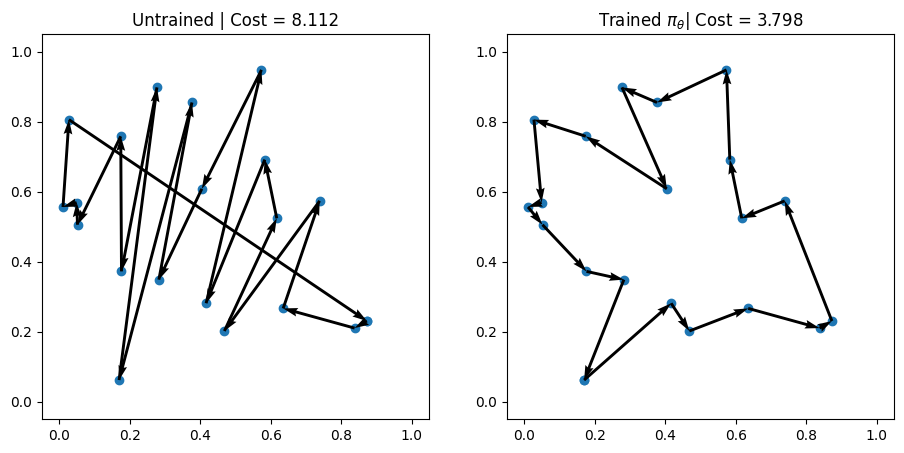
We can see that solutions are way better than with the untrained model, even just after 3 epochs! 🚀